Free · runs in your browser
Performance testing for radiation measuring instruments
The performance tests an IEC standard defines for an instrument class are its characteristic evaluation: energy and angular response, linearity, statistical fluctuation, response time and alarm accuracy. Radiation measuring instruments are standardised by class, each class under its own standard. This site covers those standards — what each one applies to, which characteristics it requires, and how the tests are performed — and provides a free browser tool that computes the results. Written for instrument manufacturers, radiation safety officers and radiation workers.
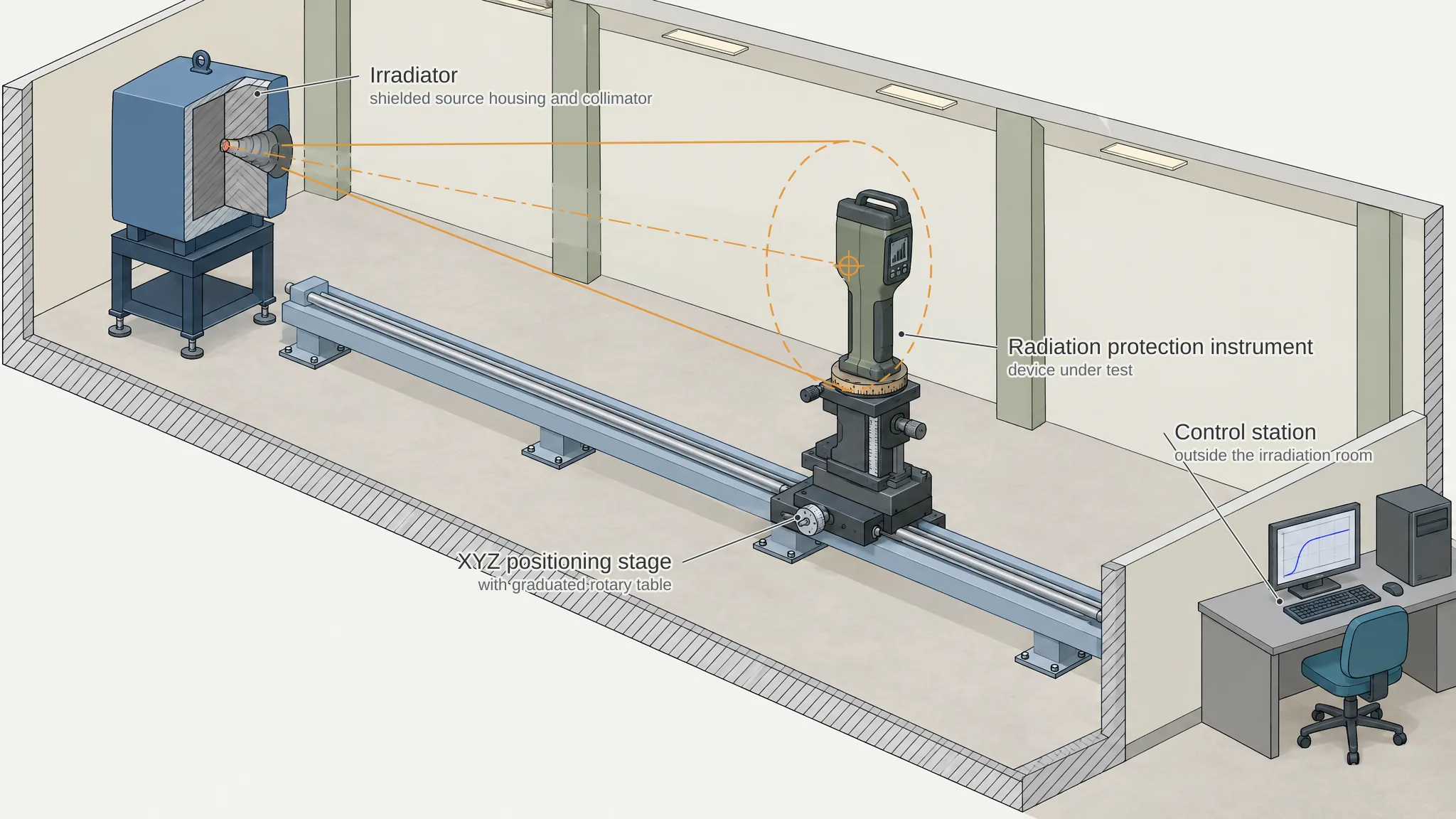
Instrument classes
The standard follows the instrument, not the radiation. A gamma survey meter, a gamma personal dosimeter and an installed gamma area monitor are evaluated under three different standards. One evaluation tool is available today; the other classes are covered as reference material.
| Instrument class | Standard | On this site |
|---|---|---|
| Portable survey meters, dose rate meters and area monitors | IEC 60846-1:2009 | Tool available |
| Electronic personal dosimeters worn on the body | IEC 61526:2024 | Reference |
| Environmental dose rate monitoring stations and mobile survey equipment | IEC 61017:2016 | Reference |
| High-range portable instruments for emergency response | IEC 60846-2:2015 | Reference |
| Passive dosimetry systems — thermoluminescence, optically stimulated luminescence and film | IEC 62387:2020 | Reference |
| Neutron survey meters | IEC 61005:2014 | Reference |
| Fixed area monitors and warning assemblies in facilities | IEC 60532:2010 | Reference |
| Surface contamination meters and monitors | IEC 60325:2002 | Reference |
These are a part of what IEC subcommittee SC 45B publishes. The standards section lists its working groups and the full catalogue.
Available tools
All toolsOne instrument class has an evaluation tool so far — IEC 60846-1:2009. Describe the instrument, enter reference values and indications per test point, and read the outcome. Everything runs in the browser: sessions and acceptance criteria stay on your device, the Excel export is generated locally, and nothing is uploaded. The tools section lists what each one computes, which evaluations it performs and which standards are not yet implemented.
Describe the instrument
Model, serial number, measuring range and the intended use of the instrument.
Enter the readings
Reference values and indicated values per test point, with repeated readings where the method calls for them.
Read the outcome
Relative response, coefficient of variation and pass/fail per point — then export the whole session to Excel.
Data handling
Every calculation runs in your browser. Sessions, presets and acceptance criteria are stored in your browser's local storage, and the Excel export is generated locally and downloaded straight to your device. Instrument identifiers and readings are never sent to a server.
The flip side: clearing your browser data clears your history. Export anything you need to keep.
Standards
Radiation measuring instruments are standardised by IEC TC 45 / SC 45B, and the standard follows the instrument class. Each class is treated the same way here: the standard's own page first, then its test procedures, then a tool. Of the 8 standards described, 1 has an evaluation tool so far — IEC 60846-1:2009.
Electronic personal dosimeters, environmental monitoring stations, neutron survey meters and contamination meters each have their own standard. The standards section identifies the committee, its working groups and which standard applies to which instrument.
Regional and national adoptions carry later publication dates, which is a common source of confusion when a report cites a year that does not match the international edition. Each standard's page shows that edition as published.
This site is independent and is not affiliated with the IEC. It cites clause numbers and describes methods in its own words; it does not reproduce the text or tables of the standard.
Documentation
What the tools do, the standards behind them, the instrument classes they apply to, and the reference material around them. Written in our own words; clause numbers are cited for reference. Test procedures sit under the standard that specifies them.
- Evaluation tools What the tools compute, which instrument class can be evaluated today, and what the other standards need before a tool can follow.
- IEC standards The IEC, the committee that writes the standards for radiation measuring instruments, its working groups, and a page for each standard covered — with its test procedures.
- Instruments by purpose Protection instruments and quality control instruments — form, quantity, performance requirements and the governing IEC standard.
- Guides Reference material that applies whichever standard you work to — operational quantities, radiation qualities, measurement uncertainty, interpretation of results.
Coverage
The calculation engine is verified against a fixed set of golden vectors on every change. The written material covers each standard, each test and the reference topics around them. What is still growing is coverage: one instrument class has an evaluation tool, and the others are reference material until their acceptance criteria are implemented. If a result looks wrong, or the instrument class you need is not covered yet, please say so — get in touch.